NASA Advances Blue Moon Mark 2 Integration for Artemis Missions
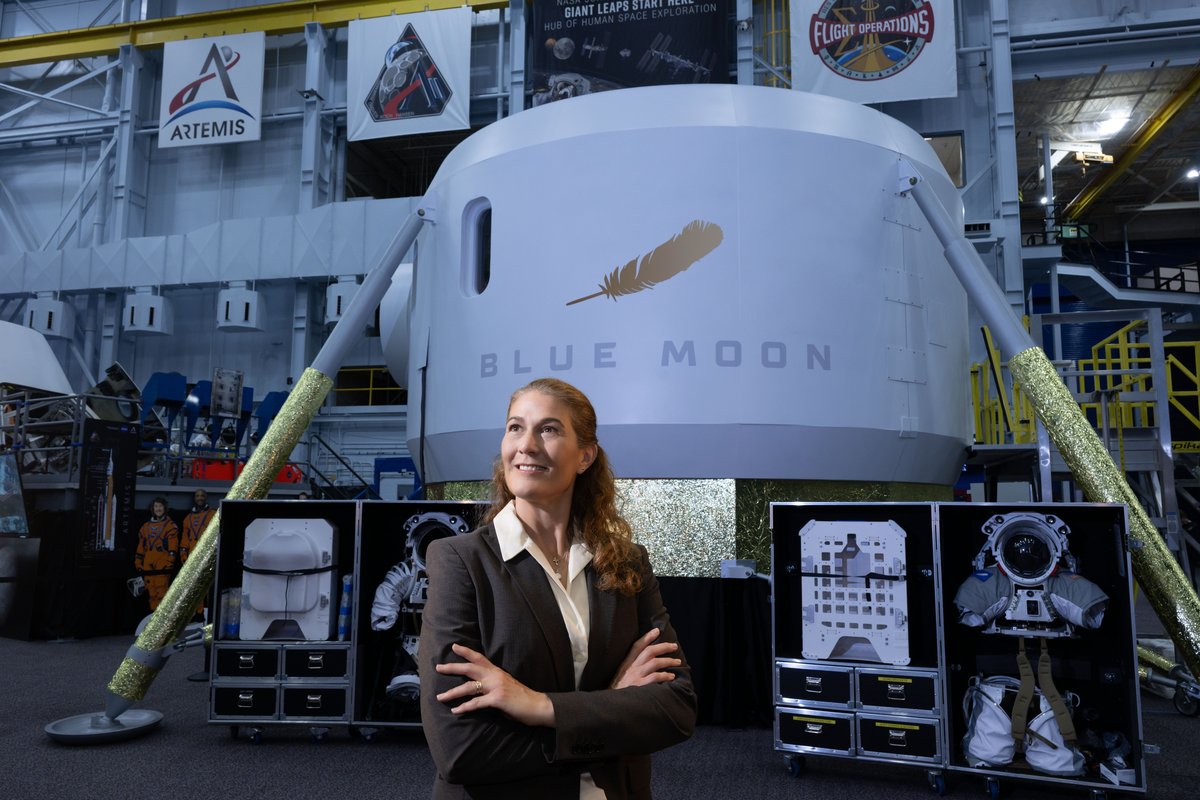
NASA lander integration lead Katie Spicer directs technical coordination for Blue Origin's Blue Moon Mark 2 human landing system under the Artemis program.
EXECUTIVE BRIEF // KEY TAKEAWAYS
NASA lander integration lead Katie Spicer directs technical coordination for Blue Origin's Blue Moon Mark 2 human landing system under the Artemis program.
National Aeronautics and Space Administration (NASA) officials are advancing the technical integration of commercial lunar landers under the Artemis campaign, with NASA lander integration lead Katie Spicer directing agency coordination for Blue Origin's Blue Moon Mark 2 human landing system. Disclosed in an agency profile by NASA News Releases, Spicer's mandate centers on aligning the commercially developed spacecraft with NASA's stringent human-rating, mission assurance, and orbital architecture requirements as the agency prepares for sustained crewed operations on the lunar surface.
The integration of the Blue Moon Mark 2 lander represents a pivotal operational milestone in NASA's transition from single-vendor government-owned spacecraft to a competitive, dual-provider commercial lunar transportation model. For the global aerospace sector and defense industrial base, the Human Landing System (HLS) program demonstrates how fixed-price public-private partnerships require deep engineering synchronization between federal space agencies and commercial prime contractors to mitigate schedule risk and ensure crew safety in deep-space environments.
Commercial Lander Integration and Agency Oversight
According to NASA News Releases, Spicer serves as the agency's lander integration lead specifically assigned to Blue Origin's Blue Moon Mark 2 configuration, one of the commercially provided human landing systems selected to transport astronauts to the lunar south pole region under the Artemis program. In this capacity, the lander integration role bridges NASA's systems engineering directorates and the commercial provider's development teams, ensuring that vehicle interfaces, life-support standards, and flight dynamics conform to federal human spaceflight protocols.
The Artemis architecture relies on multiple interdependent flight elements working in concert across cis-lunar space. A commercial human landing system must execute complex rendezvous, proximity operations, and docking maneuvers with either the Orion crew spacecraft or the planned Lunar Gateway space station in lunar orbit before descending to the surface. Coordinating these interfaces requires continuous technical verification across propulsion, avionics, guidance, navigation, and thermal control subsystems.
By embedding dedicated integration leads such as Spicer directly into the commercial lander development workflow, NASA maintains rigorous technical insight without reverting to traditional cost-plus contracting structures. This hybrid oversight mechanism allows commercial aerospace firms to retain design authority over their proprietary vehicle architectures while satisfying NASA's non-negotiable safety and mission integration baselines.
Operational and Industrial Impact on Lunar Architecture
The procurement and integration of a second commercial human landing system alongside initial Artemis landing capabilities is central to NASA's long-term strategy for lunar sustainability and industrial resilience. Incorporating Blue Origin's Blue Moon Mark 2 into the Artemis manifest establishes operational redundancy for crewed lunar surface access and fosters competition within the domestic space industrial base.
From an operational standpoint, managing distinct commercial lander designs requires NASA's integration teams to standardize mission interfaces while accommodating bespoke spacecraft capabilities. Key areas of technical coordination include:
First, mission systems compatibility, ensuring that command, control, and communication links between the Blue Moon Mark 2 lander, the Orion spacecraft, and NASA ground control networks operate seamlessly across deep-space communication relays. Second, crew interface and environmental control verification, certifying that cabin pressure, atmospheric revitalization, and extravehicular activity (EVA) suit ports meet NASA human health and performance standards. Third, payload and surface operations planning, aligning the lander's cargo capacity and surface power systems with the scientific instruments and mobility assets slated for deployment during extended Artemis surface stays.
For capital markets and aerospace supply chains, the steady progression of the Blue Moon Mark 2 integration effort signals sustained federal commitment to multi-vendor lunar infrastructure. Subcontractors supplying cryogenic fluid management systems, precision landing sensors, and radiation-hardened avionics benefit from predictable technical standards established through NASA's lander integration office.
Strategic Outlook and Upcoming Milestones
As the Artemis program progresses toward its next phase of crewed lunar exploration, the integration milestones managed by Spicer and the NASA human landing system team will determine the readiness of the Blue Moon Mark 2 spacecraft for integrated flight testing. Ahead of any crewed landing assignment, commercial providers must complete rigorous integrated design reviews, subsystem qualification testing, and uncrewed demonstration missions to validate end-to-end landing and ascent performance on the lunar surface.
Successfully integrating commercial human landing systems into the broader Artemis architecture will also establish the engineering and regulatory blueprint for future deep-space exploration, including prospective crewed missions to Mars. As NASA refines its collaborative model with commercial lander providers, the technical frameworks forged during the Blue Moon Mark 2 integration phase will remain a decisive factor in maintaining United States leadership in cis-lunar commerce and deep-space exploration.