NASA Highlights NGC 206 Star Cloud in Andromeda Galaxy Survey
NASA features the massive stellar nursery NGC 206 in the Andromeda Galaxy, offering deep-space observational benchmarks for extragalactic star formation.
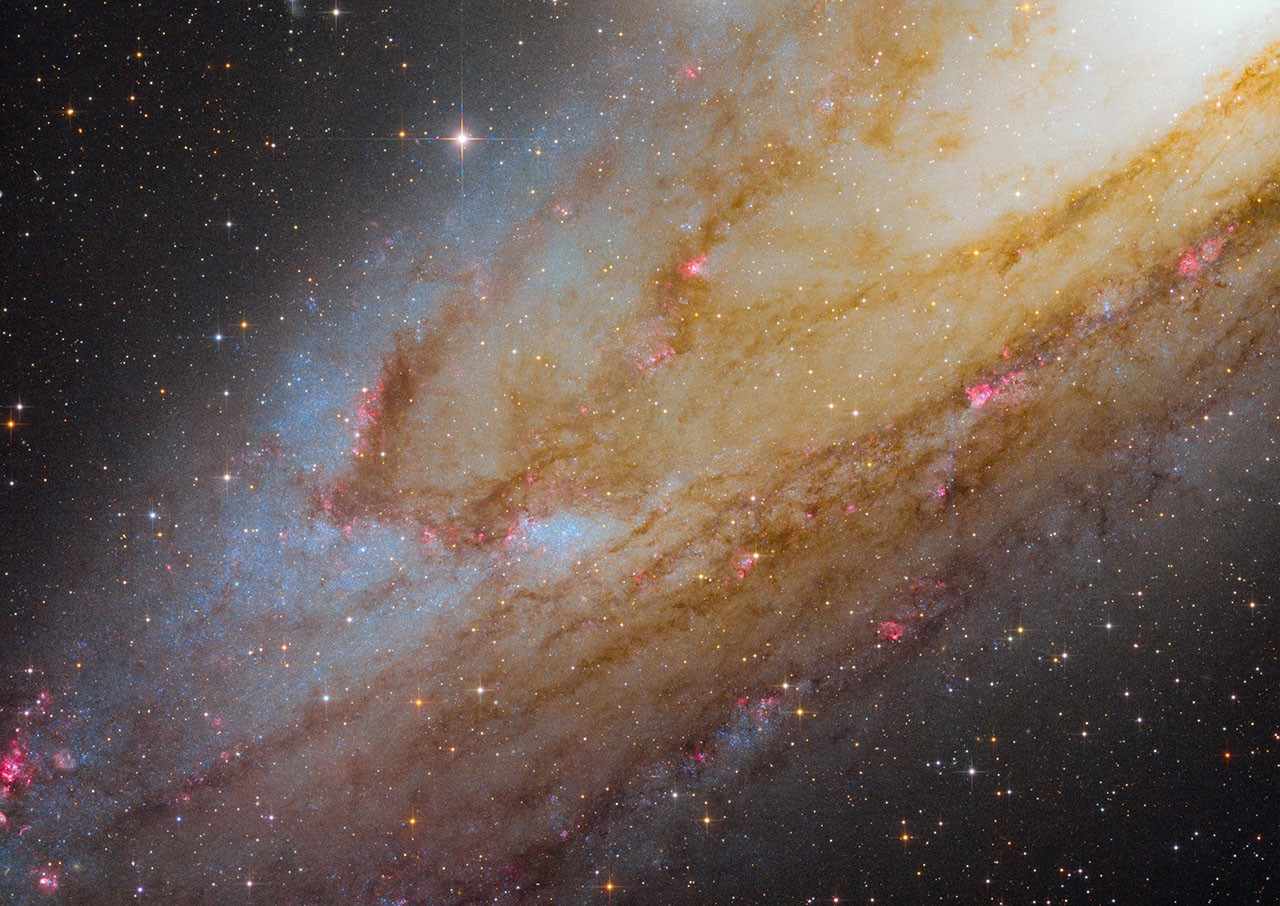
NASA News Releases featured the massive stellar association NGC 206 and the surrounding star clouds of the Andromeda Galaxy in its November 13, 2026 Astronomy Picture of the Day (APOD) dispatch. Curated and annotated by professional astronomers for NASA's daily science outreach and observational archive, the featured imagery captures one of the largest known star-forming regions within the Local Group of galaxies. Located inside the southwestern spiral arm of the Andromeda Galaxy, also cataloged as Messier 31 (M31), NGC 206 provides astronomers and astrophysical researchers with a high-resolution laboratory for studying extragalactic stellar evolution, dust lane morphology, and OB stellar associations outside the Milky Way.
For the global space science sector, observational astronomy institutions, and aerospace sensor developers, detailed wide-field imaging of Andromeda's star clouds serves a vital role in calibrating deep-space optical and infrared instruments. As space agencies and commercial observatory operators expand spectroscopic and photometric surveys across neighboring galaxies, resolved stellar populations in NGC 206 offer essential benchmark datasets. Analyzing how massive young stars ionize surrounding interstellar gas and carve out cavities in galactic dust lanes informs computational models of galaxy evolution, spectral energy distribution, and automated celestial cataloging.
Observational Context and Galactic Structure
According to NASA's Astronomy Picture of the Day program, which pairs daily astronomical imagery with technical explanations authored by professional astronomers, NGC 206 stands out as a prominent bright blue star cloud embedded within the dusty spiral arms of Andromeda. Unlike globular clusters, which consist of dense, gravitationally bound populations of ancient stars orbiting a galaxy's halo, NGC 206 is a sprawling, relatively young stellar association rich in luminous blue supergiants and hot main-sequence stars. These massive stars emit intense ultraviolet radiation that illuminates and sculpts the surrounding molecular clouds, creating a stark visual contrast against the dark lanes of interstellar dust that thread through M31's disk.
Because the Andromeda Galaxy lies approximately 2.5 million light-years from Earth, it is the closest major spiral galaxy to our own Milky Way. While our view of large star-forming complexes within the Milky Way is frequently obscured by dense foreground dust along the galactic plane, Andromeda's inclined orientation allows terrestrial and orbital telescopes to observe an entire galactic disk from an external vantage point. Within this broader galactic architecture, NGC 206 spans roughly 4,000 light-years across, making it substantially larger than typical open clusters observed in our immediate solar neighborhood and comparable in scale to the largest stellar nurseries in the Local Group.
Astrophysical Impact and Multi-Wavelength Calibration
The study of NGC 206 and Andromeda's broader star clouds carries direct operational importance for multi-wavelength astrophysical research. High-mass stars within NGC 206 evolve rapidly over timescales of only a few million years before terminating in core-collapse supernovae, enriching the interstellar medium with heavy elements and triggering secondary waves of star formation through shockwave compression. By resolving individual luminous stars alongside diffuse hydrogen-alpha emission regions, astronomers can measure the initial mass function, star formation rates, and chemical abundance gradients across an external spiral arm with high precision.
Furthermore, deep-sky imagery featured through NASA's archival programs bridges professional observatory pipelines and advanced astrophotography networks. Modern optical CMOS and CCD imaging arrays, combined with narrowband filters isolating ionized hydrogen, oxygen, and sulfur emissions, enable researchers to map the boundary layers where stellar winds interact with cold neutral gas. Cross-referencing optical observations of NGC 206 with archival ultraviolet and infrared datasets allows astrophysics teams to quantify dust extinction laws and refine distance indicators, such as Cepheid variable stars, which anchor the extragalactic distance scale.
Strategic Outlook for Extragalactic Surveys
Looking ahead, high-contrast stellar associations like NGC 206 will remain primary calibration and research targets as next-generation wide-field survey telescopes and orbital spectrographs expand their operational footprints. Upcoming large-scale sky surveys are designed to combine wide fields of view with deep photometric sensitivity, enabling continuous monitoring of variable stars, transient phenomena, and stellar population dynamics across the entire disk of the Andromeda Galaxy.
As computational astrophysics increasingly relies on machine-learning classification pipelines to process petabytes of astronomical imaging data, well-characterized structures documented in NASA's APOD archive provide indispensable training and validation references. Continued high-resolution monitoring of NGC 206 and the star clouds of Andromeda will deepen scientific understanding of how spiral galaxies sustain star formation across cosmic time while fostering broader public and institutional engagement with frontier space science.
本記事は The OmniWire の編集基準に準拠して作成されています。一次報道は公式通信社の公表情報に基づいています。